
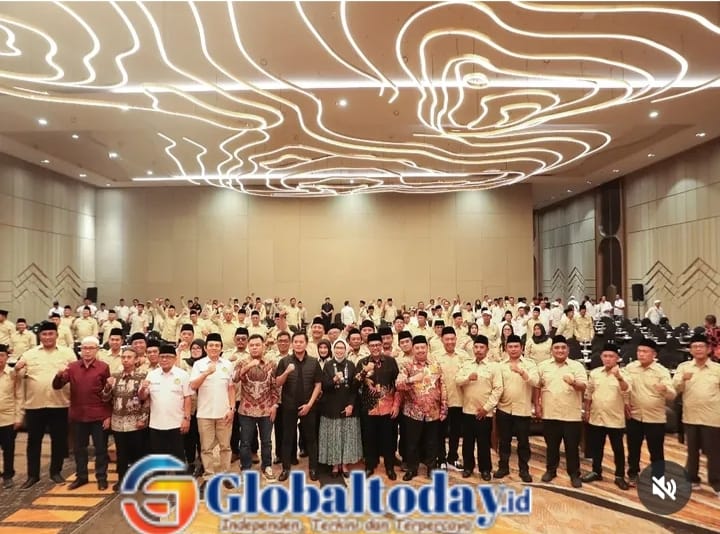
Globaltoday.id, Lumajang – The inauguration of the East Java Regional Board of Persaudaraan Kepala Desa Indonesia (PKDI) has become a key moment to redefine the role of village leadership as a collaborative force to solve grassroots problems more effectively.
Regent of Lumajang, Indah Amperawati, emphasized that PKDI should not merely function as a communication forum, but as a strong platform for cooperation among village heads to deliver real solutions for communities.
“PKDI must serve as a collective workspace. It is where village leaders share ideas, accelerate problem-solving, and ensure that every program truly meets the needs of the people,” she stated during the inauguration event at Mercure Hotel Ballroom Surabaya on April 29, 2026.
Stronger Collaboration for Complex Challenges
According to the Regent, development challenges at the village level are becoming increasingly complex and cannot be addressed individually. Strong collaboration among village heads is essential to ensure faster, more accurate, and measurable solutions.
She highlighted three main priorities for collective action:
* Improving the quality of public services in villages
* Strengthening community social resilience
* Optimizing local economic potential
“When village heads move together, public services improve, communities become stronger, and local economic potential can grow significantly,” she explained.
From Administrative to Solution-Oriented Governance
Indah Amperawati also underlined the strategic role of PKDI in accelerating village transformation—from a purely administrative approach to a more solution-oriented and results-driven system.
“Villages today are expected not only to run programs but also to solve real problems. That is why structured and sustainable collaboration is crucial,” she added.
Building a Strong Village Network
She hopes that through PKDI, village heads will no longer work in isolation but become part of a solid network that supports and strengthens one another in facing development challenges.
This collaborative approach is expected to create more responsive governance at the village level and ensure that development truly benefits the community.